Midi Lathe vs Full-Size Lathe: Which Should You Buy?
Midi lathe versus full-size floor lathe, compared by project size, price, electrical needs, and upgrade path: a direct answer to the common beginner fork.
Midi lathes run on 115 volts, weigh under 140 lbs, swing 12 inches, and cost $800 to $1,200. Full-size floor lathes require 220 volts, weigh 400-plus pounds, swing 16 to 22 inches, and cost $2,500 to $6,000. The fork is the bowl size you turn regularly: if that’s under 12 inches, a midi covers it.
That answer is more complete than it sounds. Most first-time buyers choosing between these classes have not yet turned a bowl, which means they do not yet know how large their work will be. This guide works through the decision factors so you can choose before you have that experience.
The class comparison
| Factor | Midi Lathe | Full-Size Floor Lathe |
|---|---|---|
| Swing | 12 to 16 in | 16 to 22 in |
| Between centers | 18 to 21 in | 36 to 42 in |
| Voltage | 115V | 220V |
| Weight | 70 to 140 lbs | 400 to 726 lbs |
| Price range | $370 to $1,200 | $2,500 to $6,000 |
| Footprint | Bench-top | Floor-standing |
| Setup | Plug in and go | Requires 220V circuit |
The decision usually comes down to three factors: bowl size, shop electrical setup, and budget. Each deserves more detail than a table cell provides.
Bowl size
Twelve inches is the swing limit on most midi lathes. The Jet JWL-1221VS has a 12.5-inch swing; the Rikon 70-220VSR has 12 inches. A bowl blank that measures 11.5 inches across fits with a half-inch of clearance on each side. An out-of-round blank at 12 inches may not clear without some preliminary shaping on a bandsaw first.
In practical terms, a midi lathe produces bowls up to about 10 to 11 inches finished diameter reliably. Pushing to 12 inches requires a well-prepared blank.
Full-size lathes open the range. The Powermatic 3520C has a 20-inch swing. The Grizzly G0766 has 22 inches. Turners making serving bowls, salad bowls, and decorative vessels at 14 to 18 inches need that capacity.
The exception in the midi class is the Laguna Revo 1216. At 16-inch swing, it sits between the midi and full-size segments in capacity while still running on 115 volts. If your target is 14-inch bowls but you want to avoid the 220-volt setup, the Revo 1216 is the machine to look at first.
Electrical requirements
Midi lathes plug into a standard 115-volt household outlet. You put the lathe on the bench, plug it in, and turn. No electrician required.
Full-size floor lathes run on 220 volts and draw 10 to 20 amps depending on the motor. You need a dedicated 220-volt circuit. In most North American homes and garages, running a new 220-volt circuit costs $200 to $500 in electrical work. If your shop already has 220-volt service from an existing welder, compressor, or electric dryer circuit nearby, the cost may be negligible. If not, it is a real upfront cost to budget alongside the machine price.
The Jet JWL-1840EVS at roughly $2,500 is a useful reference point here. It is a full-size lathe by swing (18 inches) but can be configured for 115 volts at reduced power output. That option reduces the electrical barrier for buyers entering the full-size class without existing 220-volt service.
Spindle turning and between-centers capacity
Bowl turning is the headline use case for this comparison, but spindle turning is where the between-centers gap matters most.
Midi lathes typically offer 18 to 21 inches between centers. The Jet JWL-1221VS has 20-1/4 inches; the Rikon 70-220VSR has 20 inches. That range covers chair rungs, short decorative spindles, and legs up to about 17 inches of usable turning length.
Standard furniture legs run from 17 to 29 inches. Table legs at 28 inches require a full-size lathe. Full-size machines with 36 to 42 inches between centers handle that range without compromise. The Grizzly G0766’s 42-inch capacity is the longest in the production full-size segment.
Weight and stability
Midi lathes weigh between 70 and 140 lbs. The WEN 3424T is 70 lbs; the Jet JWL-1221VS is 121 lbs. At the lighter end, the machine vibrates more at speed. Turners mounting large, unbalanced bowl blanks on a 70-lb lathe often add sandbags to the stand or bolt the machine to a heavy workbench.
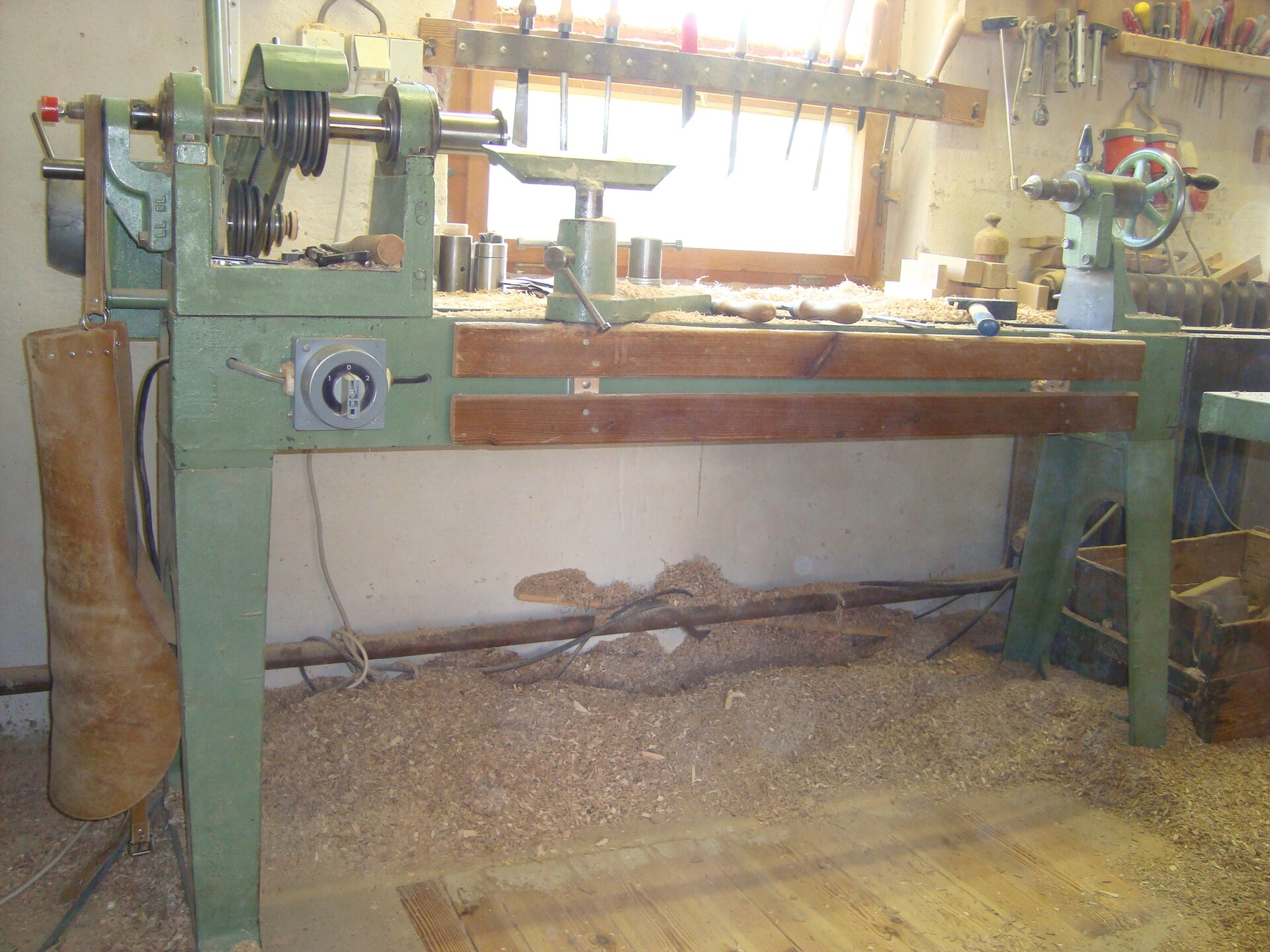
Full-size floor lathes weigh 400 to 726 lbs. The Powermatic 3520C is 726 lbs. At that mass, vibration from out-of-round blanks largely disappears into the weight of the machine. The lathe stays in place.
This matters for both safety and cut quality. A vibrating lathe makes precise cuts harder and walks across the shop if not anchored. Mass is the simplest solution to both problems, and it is part of what you are paying for in the full-size class.
Current machines in each class
Midi class (12 to 16-inch swing):
- WEN 3424T at $369: 5-speed belt, 12-inch swing, 18-inch centers. The value entry.
- Rikon 70-220VSR at ~$700: variable speed, 12-inch swing, 20-inch centers.
- Laguna Revo 1216 at ~$850: variable speed, 16-inch swing, 115V. Bridges the two classes.
- Jet JWL-1221VS at ~$990: variable speed, 12.5-inch swing, 20-1/4-inch centers, 121 lbs.
Full-size class (16 to 22-inch swing):
- Jet JWL-1840EVS at ~$2,500: 18-inch swing, variable speed, 115V option.
- Powermatic 3520C at $5,999: 20-inch swing, sliding headstock, 726 lbs, 5-year warranty.
- Grizzly G0766 at ~$4,000: 22-inch swing, 3 HP VFD, 42-inch centers, fixed headstock.
The upgrade path
Most turners start with a midi and move to a full-size lathe if their work outgrows it. The upgrade has a few friction points worth knowing before you commit.
Turning tools transfer directly. A bowl gouge, spindle gouge, or skew chisel works on any lathe in any size class. There is no tool investment to repeat.
Chucks need a different insert. Midi lathes use a 1-inch by 8-TPI spindle thread. Full-size lathes use a 1-1/4-inch by 8-TPI thread. A Nova G3 or Oneway Talon bought for a midi lathe moves to a full-size lathe with a new insert, typically $30 to $50. You are not replacing the chuck body, just the threaded insert.
Face plates and threaded accessories are thread-specific. If you accumulate several face plates on a midi lathe, those need replacements at the larger thread standard. It is not a large cost but it is real.
The direct answer
Start with a midi if: you are new to turning, your target bowls are under 12 inches, you do not have 220-volt service in your shop, and your budget is under $1,500.
Start with a full-size lathe if: you know you want bowls over 14 inches, you already have 220-volt service, and your budget reaches $2,500 or more.
For the specific comparison between the two strongest value options in the midi class, the Jet JWL-1221VS vs Rikon 70-220VSR comparison covers the decision in detail and is a useful next read if the midi class fits your work.