Wood Lathe Speed Guide: Safe RPM by Blank Size
Safe RPM ranges for woodturning by blank diameter, with the standard AAW formula, an original speed chart, and what actually happens when you run too fast.
As an Amazon Associate, Lathesong earns from qualifying purchases, at no extra cost to you.
The standard safe-speed formula for woodturning is 9,000 divided by the blank diameter in inches. At 10 inches, that gives 900 RPM. At 6 inches, 1,500 RPM. At 3 inches, 3,000 RPM. These numbers come from AAW safety doctrine and are a starting point. A well-balanced, dry blank can go faster; a wet or rough-turned blank should start lower.
This formula is the single most useful number in woodturning shop practice. It applies regardless of which machine you use.
As an Amazon Associate, Lathesong earns from qualifying purchases, at no extra cost to you.
The speed formula
The American Association of Woodturners publishes safe-speed guidance based on blank diameter. The formula:
Maximum starting RPM = 9,000 / blank diameter in inches
This produces a conservative maximum for a blank of average density and balance. A light, dry, well-balanced piece can run above this. A heavy, wet, out-of-round piece should start below it.
Speed chart by blank diameter
This table applies the formula across the common range of bowl and spindle blank sizes:
| Blank diameter | Formula result | Practical starting range |
|---|---|---|
| 4 in | 2,250 RPM | 1,800-2,250 RPM |
| 6 in | 1,500 RPM | 1,200-1,500 RPM |
| 8 in | 1,125 RPM | 900-1,100 RPM |
| 10 in | 900 RPM | 600-900 RPM |
| 12 in | 750 RPM | 500-750 RPM |
| 14 in | 643 RPM | 400-650 RPM |
| 16 in | 563 RPM | 350-560 RPM |
| 18 in | 500 RPM | 300-500 RPM |
| 20 in | 450 RPM | 200-450 RPM |
“Practical starting range” means the range for a fresh, possibly unbalanced blank. Once the blank is round and balanced, you can work toward the formula result or slightly above it. A genuinely wet, out-of-round blank straight off the bandsaw can justify starting below even that: 500 to 600 RPM at 10 inches is a reasonable opening speed until it’s trued.
What happens above the safe range
Running a blank too fast produces one of a few failure modes, in roughly increasing severity. Watch for vibration you can feel through the tool rest or bed (not the minor buzz of a slightly out-of-round blank, but movement that shakes the machine), chips flying instead of shavings curling cleanly off the edge, or any wobble in the spinning blank visible to the eye. Stop the lathe the moment any of those show up and drop the speed before restarting.
Chatter: The blank bounces against the tool rather than cutting cleanly. Cuts look rough regardless of how sharp the tool is. Dropping speed 10 to 15 percent fixes it immediately.
Vibration: The machine shakes visibly. The blank’s mass is too far from centered for the current RPM. Stop, true the blank more carefully, then restart at lower speed.
Catch-and-throw: A severe tool dig-in at high speed can propel the piece from the lathe. This is the serious hazard. A catch at 400 RPM usually spins the piece off gently; a catch at 2,000 RPM can send it across the shop with significant force. Speed is not the only factor (tool technique and blank mounting matter too), but running the blank slower gives you more reaction time.
Speed is one of two controls you have against that. The other is what you have on your face. A catch can put wood in the air at any RPM, which is why the standard at a lathe is a full face shield and not safety glasses: glasses cover the eyes and leave everything else exposed. A polycarbonate shield on ratchet headgear, like the Uvex Bionic, covers the whole face and flips up when you want a close look at the cut, which is the part that decides whether it actually gets worn. Put it on when the blank goes on, not when the work starts to feel dangerous. By then the decision has been made for you.
How speed affects cut quality
Lower speed is not always worse for cut quality. Finishing cuts on a large bowl often look better at 600 to 700 RPM than at 900 RPM, because the slower pace gives the gouge time to clear shavings and prevents heat buildup in the cut.
High speed benefits small-diameter work. A 3-inch spindle blank that runs at 2,500 RPM gives the gouge more cuts per pass and produces a cleaner surface than the same blank at 900 RPM.
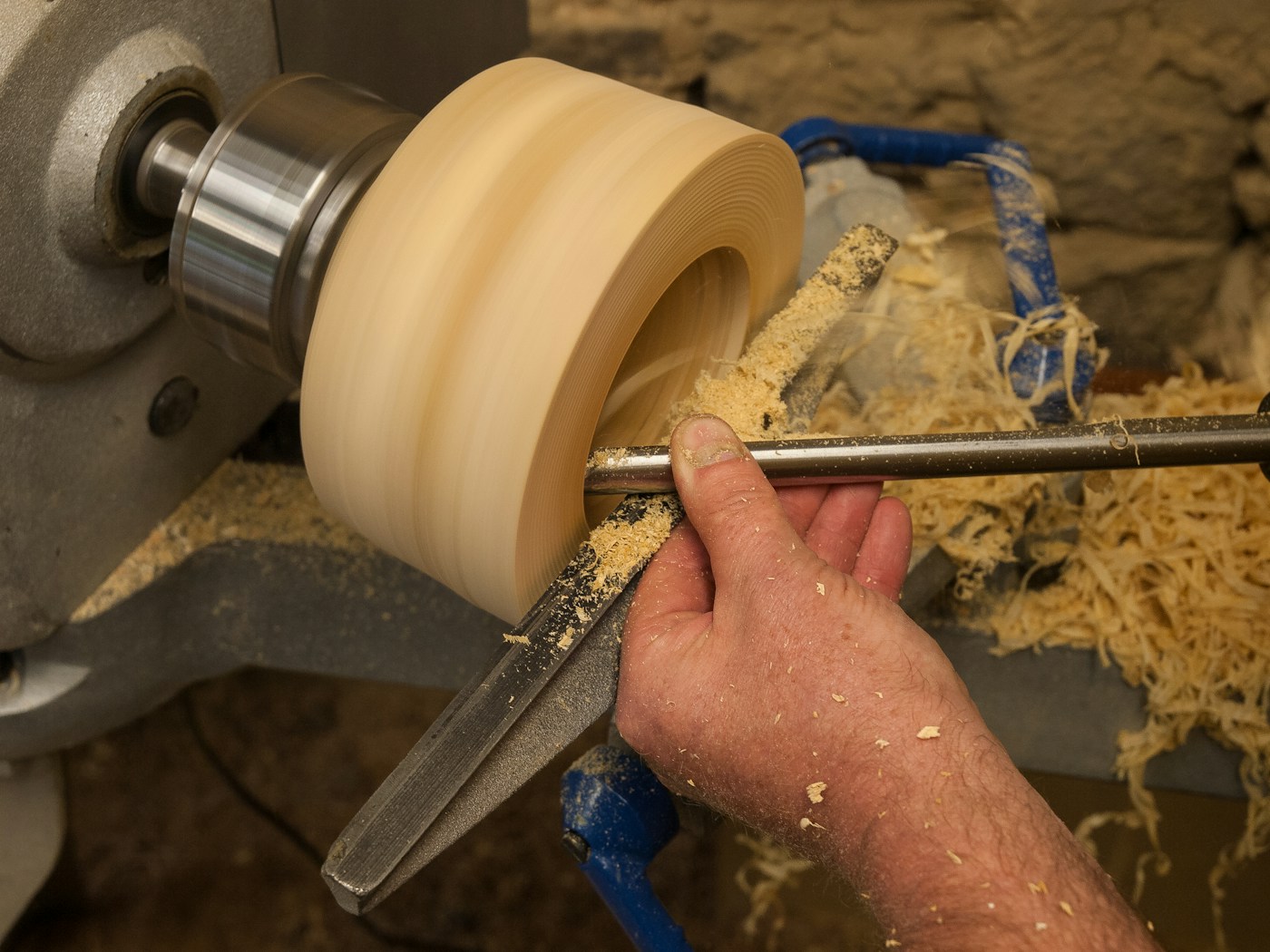
For a 10-inch bowl, that progression usually runs low, then higher, then back down again: rough at 500 to 600 RPM while the blank is still out of round, climb to 700 to 900 RPM once it’s balanced and you’re shaping the profile, then ease back to 600 to 800 RPM for the finishing pass.
Speed ranges on common machines
Jet JWL-1221VS: Three belt ranges: 60-900, 110-1,800, and 220-3,600 RPM. The low range (60-900) covers roughing blanks from 10 to 12 inches. The mid range (110-1,800) covers most bowl shaping and medium spindle work. The high range (220-3,600) covers small spindle work and pen blanks. More detail in the Jet JWL-1221VS review.
Powermatic 3520C: Two belt ranges: 15-1,200 and 40-3,200 RPM. The low range’s 15 RPM floor is exceptionally slow, which is useful for very large, unbalanced platters. More in the Powermatic 3520C review.
Grizzly G0766: Two belt ranges: 100-1,200 and 330-3,200 RPM. The 100 RPM floor is the starting point for rough turning large blanks on this machine.
Practical speed habits
Start every session lower than you think necessary. A blank that sat in the shop overnight may have dried unevenly; one end can be heavier than the other. Run it at half the formula speed for the first few passes, let it round out, then work up.
Always true the outside of the blank to round before you attempt the interior. An out-of-round blank vibrates at any speed. Getting it round at low speed costs less time than repairing a catch at high speed.
Variable speed earns its keep here. A VFD or PWM-controlled lathe lets you nudge the RPM up in small steps as the blank rounds out, without stopping the machine. A fixed belt-speed lathe forces a stop to change ranges, and in practice that means most turners just run the blank at whatever fixed speed is closest rather than the ideal one. That shortcut is usually fine once the blank is round and balanced. It’s a genuine risk on a rough, out-of-round one.
For the first bowl experience, the first bowl guide covers the step-by-step sequence including where speed changes happen in the process. For the lathe you’ll be running these speeds on, the lathe size guide covers how to match machine capacity to project size.