Laguna Revo 1216 Review: Outboard Swing and PWM Speed
Laguna Revo 1216 reviewed: three-range PWM speed control, 12.5-inch swing over bed, 16-inch outboard swing, electronics notes, and owner experience at $1,099.
As an Amazon Associate, Lathesong earns from qualifying purchases, at no extra cost to you.
The Laguna Revo 1216 is a 1 HP PWM midi lathe with three speed ranges covering 50 to 3,500 RPM and 12.5-inch over-bed swing. Its standout feature is 16-inch outboard swing for bowl turning. It retails for $1,099 at Woodcraft and Rockler as of June 2026, and is in current production.
The 16-inch outboard swing is the number that sets this machine apart at the midi class. No other lathe in the $1,000-to-$1,100 range offers outboard turning capability out of the box. The trade-off is a shorter bed: 15.5 inches between centers versus 20 to 21 inches on competitive machines. Whether that trade-off makes sense depends entirely on what you turn most.
As an Amazon Associate, Lathesong earns from qualifying purchases, at no extra cost to you.
The spec sheet
| Spec | Laguna Revo 1216 |
|---|---|
| Motor | 1 HP DC permanent magnet |
| Controller | PWM (pulse width modulation) |
| Speed range (low belt) | 50 to 525 RPM |
| Speed range (mid belt) | 325 to 1,750 RPM |
| Speed range (high belt) | 650 to 3,500 RPM |
| Swing over bed | 12.5 inches |
| Swing over banjo | 9.5 inches |
| Maximum outboard swing | 16 inches |
| Distance between centers | 15.5 inches |
| Spindle thread | 1 inch x 8 TPI (both ends) |
| Tailstock taper | MT2 |
| Tailstock quill travel | 2.5 inches |
| Weight | 118 lbs |
| Electrical | 110V, single phase, 15A circuit |
Source: Laguna Tools official specifications, verified June 2026.
Note the electrical requirement: a dedicated 15A circuit. This is standard for a 1 HP DC motor, but it’s worth confirming your bench outlet meets that spec before the lathe arrives. Owner reports connect marginal circuits and extension cords to the electronics issues this machine has seen in the field (discussed below).
Three ranges and PWM control
The Revo 1216 doesn’t offer a single continuously variable range across the full 50-to-3,500 RPM span. Instead, it uses three belt positions (low, mid, high) each covering a variable range within that band. A cam-action lever moves the belt between positions; Laguna describes this as tool-free.
Within each range, the PWM controller adjusts speed electronically. PWM (pulse width modulation) varies the power delivered to the motor in rapid cycles to maintain consistent torque at the set speed. The practical effect is similar to the auto-torque control in the Rikon 70-220VSR: the motor compensates when load increases, rather than bogging through a cut.
The 50 RPM low-end minimum is a genuine differentiator. Getting a large, freshly roughed blank into safe rotation before it’s in round requires very slow speed. Most machines in this class bottom out at 250 to 500 RPM; the Laguna’s 50 RPM floor gives more margin for difficult fresh-wood stock. Owner reports on AAW Forum confirmed the low range holds speed consistently under load rather than hunting or stalling.
The high range tops out at 3,500 RPM, which covers pen turning at the top of the high belt position. Most hobby bowl turning runs in the low and mid ranges.

The 16-inch outboard swing
The headstock spindle is threaded on both ends: 1 inch by 8 TPI on the right end (facing the tailstock) for normal inboard turning, and on the left end (facing away from the bed) for outboard turning. A faceplate or chuck seated on the left end turns a bowl with no bed rails constraining the diameter.
Over the inboard bed: 12.5-inch maximum diameter. Outboard: 16-inch maximum. That’s a 3.5-inch diameter increase, meaning the difference between a 12-inch and a 15-inch bowl on the same machine.
At the $1,099 price point, no competing midi lathe offers this. The Jet JWL-1221VS doesn’t have outboard capability. The Rikon 70-220VSR didn’t either. Getting outboard turning on a Jet or Rikon means moving to a full-size floor lathe, which puts you in a different price tier entirely.
Outboard turning requires a technique adjustment: the workpiece spins toward you on the outboard end, which reverses the standard tool approach direction compared to inboard turning. It takes a session to recalibrate if you’ve only worked inboard. The spindle rotation direction at the outboard end also means chucks and faceplates seat and tighten correctly in the outboard orientation.
An optional bed extension is available for the Revo 1216 that increases the distance between centers for longer spindle work, partially offsetting the 15.5-inch standard distance.

Build quality and physical design
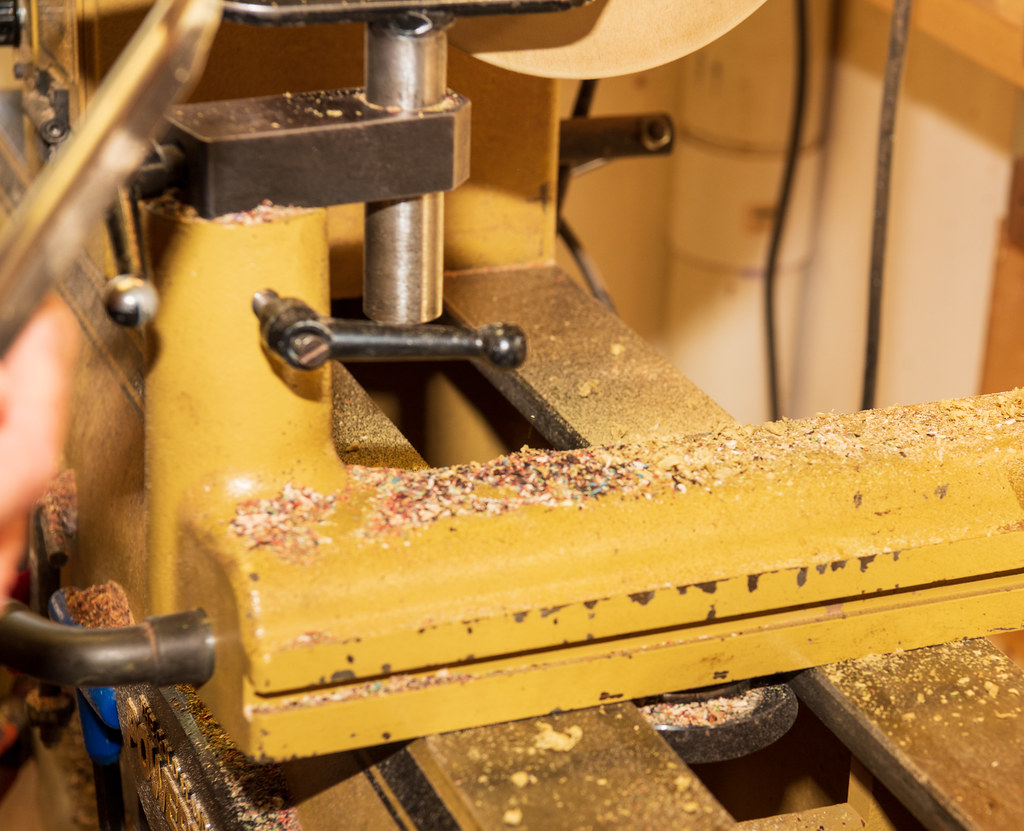
At 118 lbs, the Revo 1216 is within a few pounds of the Rikon 70-220VSR (115 lbs). The cast iron bed and headstock absorb vibration in the same class as its direct competitors.
The included accessory set is substantial: faceplate, drive center, live center (MT2), center knockout rod, faceplate wrench, and an onboard tool holder. The live center is MT2, matching the tailstock taper. This matters when buying aftermarket tailstock accessories: confirm MT2 compatibility before ordering.
The tailstock quill travel is 2.5 inches, which covers drilling operations and standard live center support. The spindle bore is 3/8 inch, standard for this class and sufficient for most hollow-vessel mandrel work.
Reverse rotation is available through the controller. Forward/reverse switching happens on the control panel. This is where the electronics concerns that owners have reported originate.
Owner reports
Woodcraft’s listing carries 32 reviews averaging 4.2 out of 5 stars (verified June 2026). Forum discussions on AAW and LumberJocks added texture to that number.
What owners consistently praise:
Torque at low speed came up repeatedly. The DC permanent magnet motor was described as having more low-RPM grunt than expected at the price point, particularly for starting rough-turning on unbalanced wet blanks. Owners who moved to the Revo from entry-level machines described the difference as immediate.
Quiet operation. The PWM controller produces smooth speed transitions; owners noted less mechanical noise than belt-drive-only machines during speed changes and at sustained RPM.
Fit and finish. Multiple owners described the machining quality as exceeding what they’d expected at $1,099, with comparisons to lathes at significantly higher prices.
The electronics issue:
Multiple LumberJocks users reported problems with the forward/reverse switch: stuck in reverse, intermittent speed fluctuation, the controller refusing direction changes. One owner replaced the switch three times in two years.
A critical detail came up in those same threads: the problems correlated with power supply quality. One user resolved a persistent stuck-in-reverse problem by plugging directly into a proper 15A outlet instead of running an extension cord from a shared circuit. Laguna’s 15A circuit requirement is in the spec sheet; the motor’s DC electronics appear more sensitive to voltage drop than the typical AC motor in this class.
The practical guidance: run the Revo 1216 on a dedicated 15A circuit with no extension cord, no power strip, no daisy-chain with other tools. This eliminates the primary category of reported issues.
When electronics problems did occur, Laguna’s customer service response was described positively across these same threads: replacement parts at no cost and responsive support.
Warranty: 2 years with registration required within 30 days of purchase. This is the shortest warranty in the peer group. The Rikon 70-220VSR carried 5 years; the Jet JWL-1221VS offers 5 years on the headstock. If warranty term is a meaningful factor in your decision, the Revo 1216’s 2-year coverage is the honest trade-off. Keep your receipt: registration is a condition of coverage, not a formality.
How it stacks up
Against the Jet JWL-1221VS: Both machines are 1 HP and land in the same $800 to $1,100 price band, so this isn’t a budget decision, it’s a capability trade-off. The Jet’s 20-1/4 inches between centers dwarfs the Laguna’s 15.5 inches, and the 5-year warranty is significantly longer. The Jet has no outboard capability. Spindle workers and turners who regularly make furniture components will find the Laguna’s short bed a real constraint. Bowl turners who want to go beyond 12.5 inches need the Laguna or a floor lathe.
Against the Rikon 70-220VSR (now discontinued; see the Rikon 70-220VSR review): The Rikon had 20 inches between centers and a 5-year warranty at a lower original price. Used Rikon examples now sit in the $400 to $650 range. The Revo 1216’s $1,099 new price buys outboard capability that the Rikon never had. The choice comes down to budget, whether you want new vs used, and whether outboard turning is worth the premium and the shorter bed.
Chuck selection: The 1-inch by 8 TPI spindle thread is the same standard as the Jet and Rikon. The Nova G3 chuck review covers the most common pairing. The G3 mounts directly on the Revo 1216’s inboard thread with no adapter, and the insert version is the one to get if there is any chance of a second lathe later. Because both ends of this spindle carry the same 1-inch by 8 TPI thread, one chuck covers inboard work and the outboard swing that makes this machine worth buying.
Who the Revo 1216 is for
Bowl turners who want outboard capability without a floor lathe. At $1,099 new, it’s the only midi machine that delivers 16-inch outboard swing out of the box. Pen turners and spindle workers who prioritize a long bed would be better served by the Jet JWL-1221VS or a used Rikon.
For setup: run it on a dedicated 15A circuit, register the warranty within 30 days, and pair it with a chuck sized for midi work. The first turning tools guide covers what goes on the tool rest; the sharpening setup guide keeps them sharp.