Woodturning Sharpening Setup: Grinder, Jig, and Wheels
The complete woodturning sharpening station: slow-speed grinder, the Oneway Wolverine jig and Vari-Grind, CBN vs aluminum oxide wheels, and the total cost.
As an Amazon Associate, Lathesong earns from qualifying purchases, at no extra cost to you.
A sharpening station for woodturning tools needs three things: a slow-speed grinder, a platform jig that holds the tool at a consistent angle across multiple sharpenings, and a wheel suited to high-speed steel. The Oneway Wolverine jig paired with a slow-speed 8-inch grinder is the setup most turners end up with. That combination runs roughly $250 to $400 depending on wheel choice, and it handles every tool in a standard turning kit.
As an Amazon Associate, Lathesong earns from qualifying purchases, at no extra cost to you.
Here’s why this matters before you discuss tools at all: a dull gouge doesn’t just stop cutting well. It catches. A catch happens when the dull bevel can’t ride the wood and the edge digs in instead. The result ranges from a startle to a piece thrown across the shop. Sharpening isn’t a maintenance task separate from turning. It’s the foundation that makes turning work.
The grinder: slow speed matters more than you think
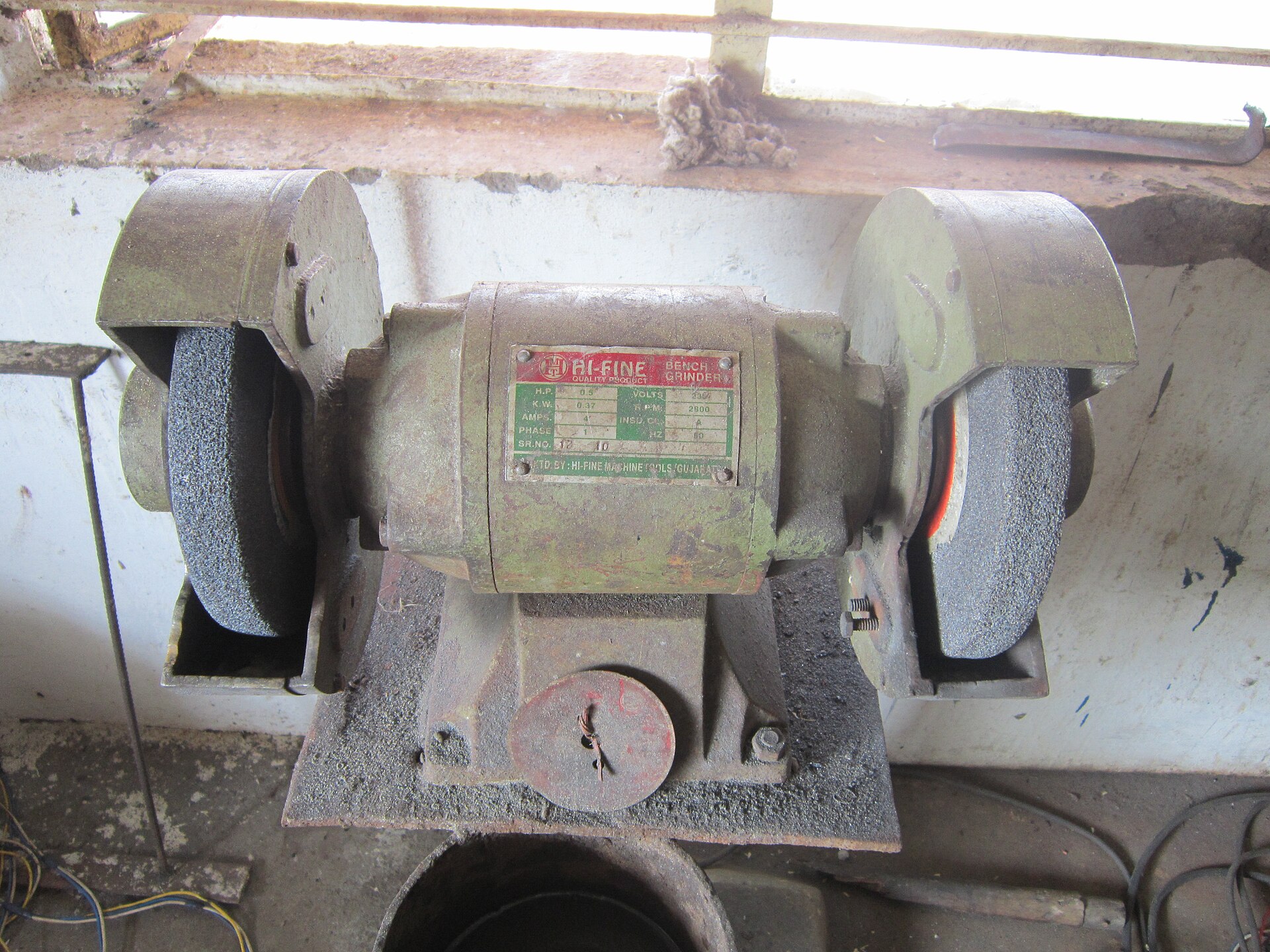
A standard bench grinder runs at 3450 RPM. That’s fast enough to remove steel quickly, which sounds like an advantage, but for woodturning tools it’s a liability. High speed means more heat at the tip, and heat is the enemy of HSS steel. If you hold a tool against a 3450 RPM wheel too long or press too hard, you draw the temper, which softens the steel and makes it hold an edge poorly. You’ll know you’ve done it when the tip turns blue.
A slow-speed grinder runs at 1750 RPM. The same amount of steel comes off, but the contact time is lower and the heat buildup is slower. The margin for error at the wheel is much wider. Beginners overheat tools. A 1750 RPM grinder makes that mistake harder to make.
6-inch vs 8-inch. Both work, but 8-inch is better for turning tools. The larger wheel diameter produces a flatter, longer bevel ground on the tool. A flatter bevel is easier to ride on the work and produces a more consistent cutting angle on bowl gouges, especially when you’re grinding the swept-back fingernail profile. A 6-inch wheel leaves a more hollow-ground bevel: workable, but not ideal for that profile. If you’re choosing a grinder specifically for turning tools, get the 8-inch.
The AAW-standard sharpening-station grinder at a reasonable price. The 1,750 RPM slow speed keeps HSS steel from overheating, and the 1 HP motor is the community pick over the 1/2 HP 80-805.
The Wolverine jig: platform plus Vari-Grind
The Oneway Wolverine is a two-piece system. The base platform mounts in front of the grinder on two adjustable arms. It has a V-groove that supports the tool handle and slides the tool across the face of the wheel at a consistent angle. This is the piece that solves the “how do I get the same bevel angle every time” problem. Without a jig, freehand grinding produces inconsistent bevels. With the Wolverine base, you get the same bevel every sharpen.
The Vari-Grind attachment is the second critical piece, and it’s specifically for bowl gouges. It’s a rotating cradle that holds the gouge flute while you sweep the tool through the arc needed to grind the swept-back wing profile that most turners call a “fingernail grind.” The Vari-Grind has an adjustable pocket that sets where the gouge sits in the cradle, which changes the bevel angle and the degree of wing sweep. Most turners find their preferred Vari-Grind setting by grinding a test bevel, measuring the result, and marking the cradle position so they can return to it.
The Wolverine base handles roughing gouges and spindle gouges at a fixed angle. The Vari-Grind handles bowl gouges with any swept-back profile. Both together cover the full range of standard turning tools.
The sharpening jig most AAW members use, which means setup help and videos are everywhere. The base kit mounts on any 6-to-8-inch grinder; bowl turners add the Vari-Grind 2 for repeatable fingernail profiles.
The Wolverine does not handle skew chisels well. A skew’s flat bevel is best sharpened on a belt sander, a flat diamond plate, or a slow-speed wheel with a flat tool rest. The platform geometry doesn’t suit the skew’s needs. This is not a flaw in the Wolverine. It’s a limitation of the application. Sharpen the skew separately.
Wheels: aluminum oxide vs CBN
Aluminum oxide wheels are what come with most grinders and what most turning tool sharpening has been done on for decades. They work. They’re cheap. The downsides are glazing (the wheel surface gets loaded with metal particles and stops cutting aggressively) and truing (you periodically need to dress the wheel face flat with a star wheel or diamond dresser). White aluminum oxide wheels are softer than gray and less likely to overheat the tool. If you’re on a tight budget, start with a good-quality white aluminum oxide wheel and learn on it.
CBN wheels (cubic boron nitride) are a one-time investment that most dedicated turners eventually make. They don’t glaze, don’t need dressing, cut aggressively and consistently, and run cooler than aluminum oxide. The expected life span of a CBN wheel is measured in decades of hobby use. The entry cost is roughly $100 to $200 per wheel depending on size and grit. Most turners buy one 180-grit CBN wheel for sharpening and one 80-grit for reshaping damaged tools or grinding new profiles.
Never glazes, never needs dressing, and runs cool enough to protect the temper on HSS steel. Confirm the arbor size and hub style match your specific grinder before ordering.
If you’re setting up from scratch with a limited budget, start with good aluminum oxide wheels and plan on upgrading to CBN once you’re sharpening tools regularly and feeling the limitations. Don’t buy the cheapest CBN wheels available. Stick to reputable vendors. Poor-quality CBN can chip or delaminate under load.
Total cost and what to buy first
| Component | Entry-level option | Better option |
|---|---|---|
| Slow-speed 8” grinder | ~$120 to $160 | ~$180 to $250 |
| Wolverine base jig | ~$65 | included in some kits |
| Vari-Grind attachment | ~$40 | included in some kits |
| Aluminum oxide wheels (pair) | ~$30 to $60 | White aluminum oxide, name-brand |
| CBN wheels (per wheel) | ~$100 to $200 | Buy later, after aluminum oxide |
A practical entry setup: a slow-speed 8-inch grinder + Wolverine base + Vari-Grind attachment + one set of good white aluminum oxide wheels. That runs roughly $250 to $350 depending on current pricing. The Wolverine jig is available as a kit that bundles the base and the Vari-Grind.
Buy the CBN wheels when you’ve been sharpening long enough to feel the difference and when the aluminum oxide wheels start showing wear. That’s the right sequencing: learn on aluminum oxide, invest in CBN when you’re committed.
The budget path: using what you have
If you have a standard 3450 RPM bench grinder, you can use it for woodturning tools with more care and more frequent dressing to manage heat. The technique is: lighter passes, more frequent lifting off the wheel, and keeping water nearby to cool the tool tip. It’s workable. It’s just less forgiving.
If you have a 6-inch grinder, the Wolverine fits it. You give up some bevel flatness compared to 8-inch, but the jig still works and the sharpening is still repeatable.
The piece you shouldn’t compromise is the jig. Freehand grinding is a skill that takes years to develop, and an inconsistent bevel produces inconsistent turning results. The Wolverine base and Vari-Grind together cost roughly $100 to $110. That’s the investment worth making first, even if you use it with an existing grinder.
For the tools themselves, the first turning tools guide covers what to buy and in what order. The sharpening station is the system that keeps those tools working.