Grizzly G0766 vs Powermatic 3520C: Value vs Premium
Grizzly G0766 versus Powermatic 3520C: $4,000 with 3 HP and 22-inch swing against $5,999 with 726 lbs of cast iron and a five-year warranty. Which to buy.
The Grizzly G0766 is roughly $4,000: 3 HP, 22-inch swing, 42 inches between centers, one-year warranty. The Powermatic 3520C is $5,999: 2 HP, 20-inch swing, 36 inches between centers, five-year warranty, 726 lbs. On capacity, the G0766 wins every spec for $2,000 less. The Powermatic buys mass, warranty, and a 70-year dealer network.
That is the honest summary. Every full-size lathe comparison in this class eventually comes down to those two sentences.
Specifications compared
| Spec | Grizzly G0766 | Powermatic 3520C |
|---|---|---|
| Motor | 3 HP (3-phase via VFD) | 2 HP EVS |
| Speed ranges | Two belt: 100-1,200 / 330-3,200 RPM | Two belt: 15-1,200 / 40-3,200 RPM |
| Swing over bed | 22 in | 20 in |
| Between centers | 42 in | 36 in |
| Headstock | Fixed | Sliding |
| Voltage | 240V single-phase | 220V |
| Weight | ~490 lbs assembled (per forum discussion) | 726 lbs |
| Warranty | 1 year | 5 years |
| Price (2026) | ~$4,000 | $5,999 |
The G0766’s 3 HP comes from a three-phase motor driven by an onboard variable-frequency drive (VFD). You run a standard 240-volt single-phase circuit from your panel, the same circuit type as a dryer or a table saw, and the VFD converts it internally. The result is variable speed in two belt ranges: 100 to 1,200 RPM on the low range, 330 to 3,200 on the high range. No three-phase utility service is required.
The Powermatic 3520C uses a 2 HP electronic variable-speed system in the same two-range arrangement: 15 to 1,200 RPM on the slow range and 40 to 3,200 on the fast range. The low-end minimum of 15 RPM is notably slower than the Grizzly’s 100 RPM floor, which matters when rough-turning badly out-of-balance blanks.
Where the Grizzly G0766 wins
Capacity on every number. The G0766’s 22-inch swing is 10 percent larger than the Powermatic’s 20 inches. Its 42-inch between-centers capacity beats the Powermatic’s 36 by six full inches. At 3 HP, it has 50 percent more horsepower. All of this for $2,000 less.
The VFD setup is also worth noting. Three-phase motors driven by VFDs are well-established in industrial machinery. The torque curve is strong across the full speed range, and the drive adds protection against motor overload. Grizzly uses this approach across its full-size lathe line. Turners discussing the G0766 on AAW forums consistently rate the power delivery as the machine’s strongest attribute.
Our Grizzly G0766 review covers the machine in detail. The short version: turners who prioritize outright capacity over a sliding headstock or premium warranty find the G0766 difficult to argue against at its price.
Where the Powermatic 3520C wins
Mass, headstock flexibility, warranty, and support infrastructure.
At 726 lbs, the 3520C is among the heaviest production floor lathes in the full-size segment. That mass absorbs vibration. Turners working with large, out-of-round bowl blanks notice the difference immediately. The G0766 at an estimated 490 lbs is not a light machine, but the 236-lb difference is perceptible when turning a rough-cut 18-inch platter at 100 RPM.
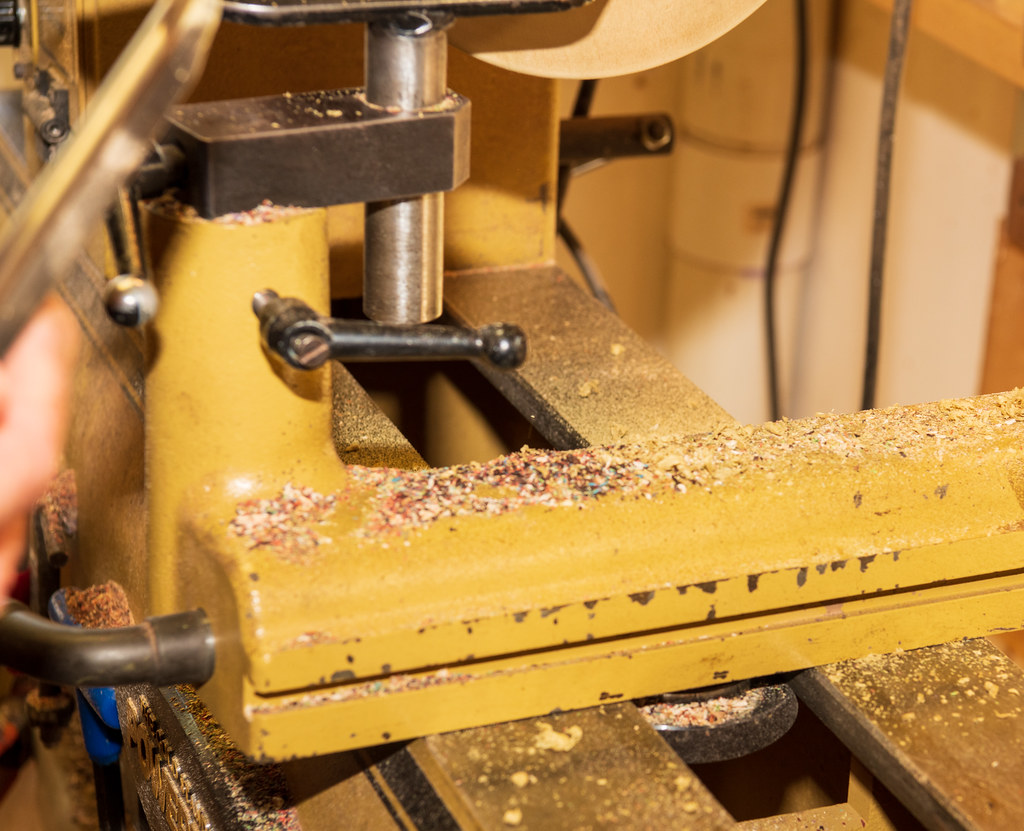
The sliding headstock is the 3520C’s most distinctive feature. It repositions along the bed to allow outboard turning of platters and large face work without the tailstock interfering. The G0766’s fixed headstock cannot do this. If outboard turning is part of your regular work, that is a real limitation.
The five-year warranty is the longest in the segment. Powermatic’s dealer network has been in place for decades. If a part fails, you call a dealer rather than navigating a direct manufacturer support line. Whether that matters depends on how far you are from a Powermatic dealer and how much you value long-term service access.
The sliding headstock question
This is the decision point for most buyers at this price level.
The Powermatic 3520C’s sliding headstock repositions the entire headstock assembly along the bed. You can face-turn a 35-inch platter off the outboard side of the spindle without any obstruction. You can also use a steady rest at the headstock end of a long spindle by sliding the headstock back toward the center of the bed.
The Grizzly G0766 does not offer this. You can turn at the outboard end of the G0766’s spindle, but the 22-inch swing limit applies in that position. For platters larger than 22 inches, the G0766 is out. For platters under 22 inches, it handles the work fine.
If you turn furniture legs, spindles, and bowls to about 18 inches, the G0766’s fixed headstock is not a limitation. If you turn large platters or vessel forms regularly, the sliding headstock earns its $2,000 premium.
Accessories and chuck compatibility
Both machines use a 1-1/4-inch by 8-TPI spindle thread, the standard for full-size floor lathes. A Nova G3 chuck with a 1-1/4 by 8 TPI insert works on either machine. Face plates, drive centers, and live centers in that thread are interchangeable between the two.
The Powermatic 3520C’s outboard spindle also accepts the same 1-1/4-inch by 8-TPI standard, so outboard face plates and chucks use the same hardware. Our Powermatic 3520C review covers accessory compatibility in full.
The Jet JWL-1840EVS as a third option
Before committing to either machine, our Jet JWL-1840EVS review is worth reading. The 1840EVS sits at roughly $2,500, has an 18-inch swing, and offers variable speed without a VFD setup. It is lighter than both the Grizzly and the Powermatic, but it is a capable entry into the full-size segment at a substantially lower price. If your bowl sizes top out at 16 inches, the 1840EVS gets you there for $1,500 less than the G0766. For how the 3520C compares against the Laguna Revo 18|36, the Powermatic vs Laguna comparison covers that pairing directly.
The verdict
Buy the Grizzly G0766 if your priority is outright capacity at the lowest price in the segment. Three horsepower, 22 inches of swing, 42 inches between centers, roughly $4,000. Accept the fixed headstock and the one-year warranty.
Buy the Powermatic 3520C if you want the heaviest machine in its swing class, a sliding headstock for outboard work over 20 inches, a five-year warranty, and dealer support rather than direct manufacturer service. Accept that you are paying $2,000 for those things, not for more capacity.
The choice is not about which machine is better overall. Both are professional-grade tools with long track records. It is about whether the sliding headstock and warranty infrastructure matter for your specific work.